Deep Root Care for Mature Trees
Deep Root Care for Mature Trees: Feeding, Watering & Root Health
A practical, evaluation-first guide to deep root feeding, deep root fertilization, and deep root watering for mature trees growing in Chicago’s compacted urban soils.
Schedule a Root & Tree Health Evaluation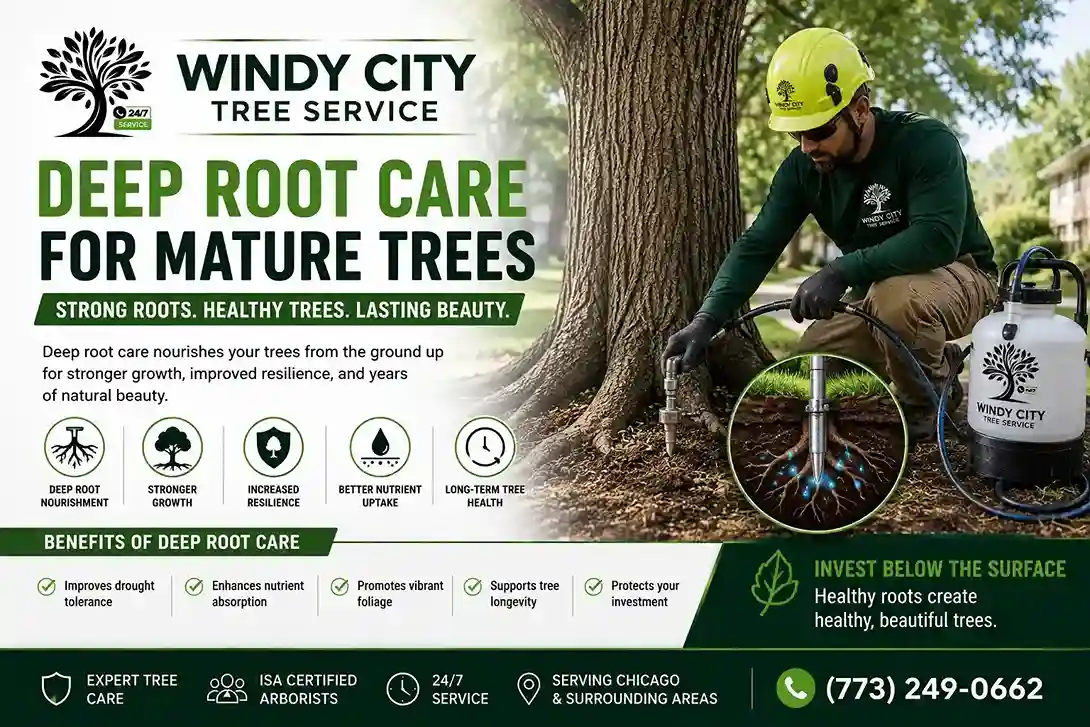
A mature tree can look completely healthy from the curb — full canopy, good color, no obvious dead wood — while the root system underneath is struggling with compacted soil, drought stress, or nutrient limitations that never show up until the decline is already underway. That’s the paradox of deep root care for mature trees: the part of the tree doing the most work is the part homeowners see the least.
Mature trees in Chicago face a specific combination of stresses. Decades-old clay soil compacts under foot traffic, driveways, and sidewalks. Construction and utility work sever roots without warning. Turfgrass competes with tree roots for the same shallow moisture. Pavement and building footprints shrink the usable rooting area year after year. None of these problems announce themselves the way a storm-snapped branch does — they build slowly, in the soil, out of sight.
That’s why root-zone care matters as much for a 60-year-old oak as pruning or storm prep does. This guide walks through the two pillars of deep root care — deep root watering and deep root feeding (fertilization) — along with the soil conditions, signs of stress, and professional practices that tie them together. Throughout, the goal is the same: match the care to what the tree’s condition, species, soil, and site actually need, not to a generic seasonal checklist.
What Is Deep Root Care for Mature Trees?
Deep root care is the ongoing management of a mature tree’s root zone so it has adequate moisture, oxygen, and nutrients. Rather than a single product, it’s a set of practices matched to the tree’s actual condition. Professional deep root care may include:
- Soil and root-zone evaluation
- Deep, slow watering across the root zone during drought
- Deep root fertilization when a nutrient need is identified
- Soil decompaction and mulch correction
- Root inspection and ongoing monitoring
Not every mature tree needs fertilizer — some only need better watering or decompacted soil.
What Is Deep Root Care for Mature Trees?
Most people picture tree roots as a mirror image of the canopy, reaching straight down into the earth. In reality, the majority of a tree’s absorbing roots live in the top 12 to 18 inches of soil, spreading out well beyond the drip line rather than plunging deep underground. These are feeder roots — fine, hair-like structures that take up water and dissolved nutrients and are the most active part of the entire root system.
“Deep root care” doesn’t mean forcing water or fertilizer far below the soil surface. It means managing the conditions across that broad, shallow root zone so feeder roots can actually do their job: enough oxygen in the soil, enough available moisture, and adequate nutrients when the tree has a genuine need. Soil that’s compacted, waterlogged, or buried under pavement restricts feeder roots no matter how much fertilizer is applied.
This is the core distinction between deep root care and simply watering the lawn or scattering fertilizer near the trunk: root care treats the whole root zone as a system, not a single point. It considers the tree’s species, the soil it’s growing in, the site’s drainage, and how those factors change from block to block across the city.
Why Mature Trees Need Root Care
A mature tree’s size can be deceiving. Age brings a larger canopy and a more established root system, but it also brings decades of accumulated site stress: soil compaction from repeated foot and vehicle traffic, a permanently reduced rooting area from patios and additions, and lawn competing for the same moisture the tree needs. In Chicago’s older neighborhoods, many mature trees are also growing in soil that was disturbed decades ago during original construction and has never fully recovered its structure.
Add to that Chicago’s specific climate pattern — hot, sometimes dry summers punctuated by heavy rain events, plus harsh winters and de-icing salt near streets and sidewalks — and mature trees are working with a narrower margin than they had as young, actively establishing trees. Mature tree care that ignores the root zone is only managing half the tree.
Common contributors to root-zone stress in mature Chicago trees include:
- Soil compaction from traffic, parking, and construction equipment
- Drought periods and urban heat-island effect
- Pavement and building footprints restricting rooting space
- Turfgrass competing for shallow soil moisture
- Poor drainage in heavy clay soils
- Changing site conditions — additions, regrading, new hardscape
- Nutrient limitations in disturbed or depleted urban soil
None of these problems are visible from the sidewalk. That’s why professional tree health inspection — not guesswork — is the starting point for deciding what a specific mature tree actually needs.
Deep Root Watering for Mature Trees
Deep watering trees means applying water slowly enough, and in a large enough area, that moisture reaches well past the surface and spreads across the active root zone — rather than a quick surface sprinkle that wets only the top inch of soil and evaporates within hours. This is fundamentally different from frequent shallow watering, which trains roots to stay near the surface and leaves the tree more vulnerable during drought.
Understanding why deep watering works starts with how water actually moves through soil. Water infiltrates downward and outward by gravity and capillary action, but compacted soil slows that movement dramatically, causing water to pool and run off rather than soak in. Sandy soil drains quickly and may need more frequent applications; heavy clay, common across much of Chicago, drains slowly and holds moisture longer but is prone to compaction that blocks infiltration altogether.
For mature trees, the goal of deep root tree irrigation is to distribute water broadly — generally from partway out from the trunk to beyond the drip line, where the majority of active feeder roots are concentrated — rather than concentrating it against the trunk, which does little for a large tree’s water needs and can contribute to trunk and root-collar decay if done repeatedly.
How to Deep Water a Mature Tree
- Check soil moisture first. Push a screwdriver or soil probe a few inches down; if it’s still moist, watering may not be needed yet.
- Identify the approximate root zone — generally the area from partway between the trunk and the drip line, out to just beyond the canopy’s edge.
- Apply water slowly using a soaker hose, drip line, or a hose set to a slow trickle, rather than a fast, high-pressure stream.
- Spread the water across the root zone instead of concentrating it in one spot near the trunk.
- Allow full infiltration before adding more; watch for pooling or runoff, which signals the soil can’t absorb water that quickly.
- Avoid runoff onto pavement or downhill — if it happens, slow down the application rate.
- Check soil moisture again a few inches down to confirm the water actually reached root depth.
- Adjust frequency based on current weather, rainfall, and how quickly the soil dries out at that specific site.
How Often Should You Deep Water Mature Trees?
There’s no single watering schedule that fits every mature tree. How often to deep root water trees depends on species, canopy size, soil type, drainage, current rainfall, temperature, and whether the tree is already showing signs of drought stress. A silver maple in heavy, moisture-retentive clay has very different needs than an oak in well-drained, elevated parkway soil.
As a general pattern, established mature trees typically need less frequent supplemental watering than newly planted trees, because their more extensive root systems can draw moisture from a wider area. That said, “established” doesn’t mean “drought-proof.” During Chicago’s hotter, drier summer stretches, many mature trees benefit from deep watering roughly every one to two weeks in the absence of meaningful rainfall — adjusted up or down for soil type and species. During a normal rainfall pattern, supplemental watering may not be necessary at all.
Watch for early drought-stress signals — wilting or curling leaves in the heat of the day, premature leaf drop, or a dull, off-color canopy — as a cue to check soil moisture rather than relying purely on the calendar.
Deep Root Watering Systems for Trees
Several approaches can deliver water effectively to a mature tree’s root zone. The right one depends on the site, tree size, and how much ongoing attention the homeowner wants to give it:
- Slow-soak hose watering: A hose set to a trickle, moved periodically around the root zone — simple, effective, and requires no equipment investment.
- Soaker hoses: Laid in a spiral or loop pattern under mulch across the root zone for even, low-pressure distribution.
- Drip irrigation: Emitters placed at intervals across the root zone deliver a slow, consistent supply, useful for larger properties with multiple trees.
- Root-zone irrigation systems: Installed systems designed specifically to distribute water below mulch and across a defined root area.
- Professional deep-root irrigation methods: Arborists may use root-zone probes or specialized equipment for targeted watering during severe drought or for high-value trees.
Whatever method is used, the principle is the same: slow, even distribution across a broad area beats a fast, concentrated soak near the trunk every time.
What Is Deep Root Feeding?
Deep root feeding — also called deep root fertilization — refers to placing fertilizer within the root zone, typically at a shallow-to-moderate soil depth, so nutrients reach active feeder roots more directly than a surface broadcast application. Professional applications often use specialized equipment to place fertilizer at multiple points across the root zone, avoiding surface runoff and getting nutrients closer to where roots can actually absorb them.
It’s worth separating two ideas that get used interchangeably: simply “fertilizing a tree” can mean scattering granular product on the surface near the trunk, while true deep root feeding is a more deliberate placement method, generally reserved for situations where a nutrient deficiency has been identified and surface application isn’t expected to reach the root system effectively — for example, in compacted soil or under a thick turf layer.
Deep root feeding is a tool, not a default. It’s most useful when there’s a specific reason to believe the tree needs supplemental nutrition — not as a routine, automatic treatment applied to every mature tree on a property regardless of condition.
Does Deep Root Fertilization Work?
This is one of the most common questions homeowners ask, and the honest answer is: it depends on whether the tree actually has a nutrient need. When a documented or clinically likely deficiency exists — identified through soil testing, foliar analysis, or an arborist’s assessment of symptoms and site history — an appropriately formulated fertilizer applied at the right time can support the tree’s recovery and long-term vigor.
Fertilization is not a cure-all. It will not reverse drought damage, correct a compaction problem, treat a fungal disease, or compensate for root loss from construction. Applying fertilizer to a tree whose real problem is poor drainage or physical root damage won’t address the underlying cause and, in some cases, can add stress rather than relieve it.
The factors that determine whether deep root fertilization will actually help include:
- Whether a nutrient deficiency is present and correctly identified
- Soil pH and existing nutrient levels (from soil testing)
- Tree species and its typical nutrient requirements
- Site conditions — drainage, compaction, and rooting space
- Whether the fertilizer formulation and timing match the specific need
- Avoiding excessive or repeated application beyond what’s needed
The most reliable way to know whether deep root fertilization will work for a specific tree is a professional evaluation — not a standing assumption that every mature tree benefits from an annual feeding.
Benefits of Deep Root Feeding for Mature Trees
When deep root fertilization is properly prescribed — meaning it’s targeted at a real, identified need — it can offer meaningful benefits:
- Supporting healthy foliage color and density in trees with a confirmed nutrient deficiency
- Supporting root development in soils that are nutrient-limited
- Correcting specific deficiencies, such as iron or nitrogen shortfalls identified through testing
- Supporting recovery from certain stress events when nutrition is a contributing factor
- Maintaining vigor in mature trees growing in poor or depleted urban soils over the long term
The key qualifier throughout is “when appropriate.” Benefits depend entirely on whether the tree’s actual condition calls for supplemental nutrition — a healthy mature tree in good soil generally won’t show measurable improvement from routine fertilization it didn’t need.
Not sure if your tree needs fertilizer?
An ISA-certified arborist can evaluate your tree’s canopy, soil, and root zone and tell you honestly whether deep root feeding will help — or whether the real issue is something else entirely.
How Deep Root Fertilization Is Applied
Professional deep root fertilization follows a structured process rather than a single mechanical step:
- Tree assessment — evaluating canopy condition, growth rate, and visible symptoms
- Root-zone evaluation — mapping the approximate extent of the root system relative to the site
- Soil and site evaluation — checking drainage, compaction, and, when warranted, a soil test
- Identification of nutrient needs — matching symptoms and soil results to a likely deficiency
- Selection of an appropriate treatment — the right formulation and rate for the tree and site
- Application around the root zone — placing the treatment at multiple points across the active rooting area
- Monitoring and follow-up — tracking the tree’s response over subsequent growing seasons
Professional root feeders and injection equipment place fertilizer at a shallow-to-moderate depth in a grid or radial pattern across the root zone, which distributes nutrients more evenly than a single surface application. This equipment is designed for controlled, professional use — it isn’t a substitute for identifying whether fertilizer is the right treatment in the first place.
When Is the Best Time to Deep Root Fertilize Trees?
There isn’t one universal “best” season for every tree — timing depends on species, local climate, soil conditions, the specific deficiency being addressed, and the tree’s overall condition. That said, arborists generally plan applications around a tree’s natural root-growth periods, avoiding times of active stress such as the height of summer heat or drought.
| Season | Deep Root Care Considerations |
|---|---|
| Spring | Evaluate canopy growth and soil conditions as the tree resumes active growth; a common window for fertilization if a need was identified. |
| Summer | Prioritize moisture management and drought-stress monitoring; fertilization is generally avoided during peak heat stress. |
| Fall | A frequently favored window for nutrient treatments, timed to support root activity before winter dormancy — depending on species and tree needs. |
| Winter | Generally a period for assessment and planning rather than active treatment, while the ground allows. |
The right timing for a specific tree is best determined after an arborist evaluates its condition — not from a fixed date on the calendar.
Deep Root Feeding vs Regular Tree Fertilization
Tree-care companies use these terms somewhat differently, which can make comparison shopping confusing. In general terms, though, the two approaches differ in precision and placement:
| Factor | Surface Fertilization | Deep Root Feeding |
|---|---|---|
| Application area | Surface or shallow root zone | Root-zone placement at multiple points |
| Equipment | Basic spreader or granular application | Professional root feeder or injection equipment |
| Precision | Lower — relies on surface infiltration | More targeted placement near feeder roots |
| Soil conditions | Important for infiltration | Very important for equipment use and placement |
| Best use | Site-dependent; simpler cases | Site- and tree-condition dependent; compacted or turf-covered soils |
| Professional assessment | Sometimes performed first | Often recommended before treatment |
Because terminology varies between companies, it’s worth asking directly how a provider defines “deep root feeding” and what equipment and process they use.
Deep Root Care for Mature Trees in Chicago
Chicago’s growing conditions create a specific set of root-zone challenges that shape how deep root care should be approached locally. The city’s heavy clay soil, common across much of the metro area, drains slowly and compacts easily — a combination that limits oxygen availability right where feeder roots need it most.
Add in decades of pavement, sidewalks, and building footprints that shrink rooting space in older neighborhoods, plus repeated freeze-thaw cycles through Chicago winters, and mature trees are managing a narrower margin of soil health than trees in more open, undisturbed settings. Summer drought stretches and urban heat-island effect further increase water demand precisely when compacted soil is least able to deliver it. Near streets and sidewalks, winter de-icing salt adds another layer of root-zone stress that accumulates over years.
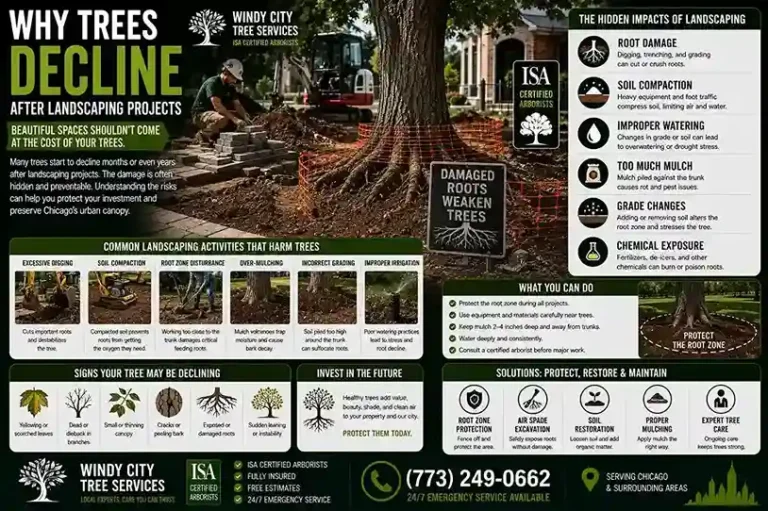
Construction activity — additions, driveway replacement, utility work — remains one of the most common and preventable causes of root damage in Chicago neighborhoods, and lawn competition for shallow soil moisture is nearly universal in residential settings.
Because these conditions compound gradually and rarely show obvious symptoms early on, mature trees throughout Chicago’s neighborhoods generally benefit from periodic professional evaluation rather than a wait-and-see approach. A trained eye can catch compaction, drainage problems, or early nutrient stress well before the canopy shows visible decline.
Signs Your Mature Tree May Need Deep Root Care
These warning signs can point to root-zone stress, though many overlap with other causes — which is why professional evaluation matters before jumping to conclusions:
- Premature leaf drop, especially compared to neighboring trees of the same species
- Small or pale leaves, or a noticeably thinner canopy than in previous years
- Reduced annual twig growth
- Dead branch tips or dieback progressing inward
- Repeated wilting during moderate heat, even with adequate rainfall
- Visible soil cracking or compacted, hard-packed soil at the root zone
- Exposed or damaged surface roots
- Excessive runoff or standing water after rain
- Recent construction, excavation, or grading near the root zone
- Mulch piled against the trunk (“mulch volcanoes”)
A single symptom rarely points to one clear diagnosis — these signs can indicate drought stress, disease, nutrient deficiency, or root damage, and often several overlap at once. For a closer look at how professionals sort through overlapping symptoms, see our guide on how certified arborists diagnose tree problems, and if you’re seeing more advanced decline, our article on signs your tree is dying covers the more serious end of the spectrum.
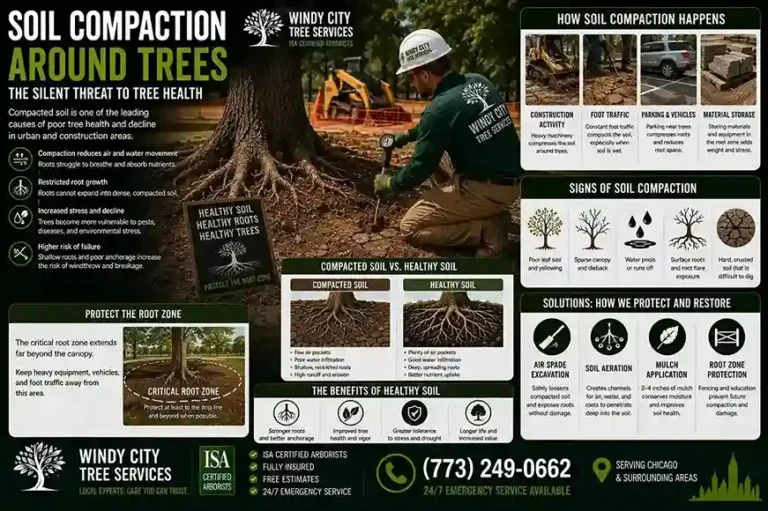
How Soil Compaction Affects Mature Tree Roots
Compacted soil is one of the most common — and most overlooked — contributors to root-zone stress in urban trees. When soil particles are pressed together by repeated foot traffic, vehicles, or construction equipment, the pore space between them collapses. That pore space is where roots find both oxygen and water; without it, feeder roots suffocate and struggle to expand into new soil.
The downstream effects compound quickly: reduced oxygen availability slows root growth, restricted water infiltration increases surface runoff instead of soaking in, and nutrient availability drops because compacted soil limits the microbial activity that makes nutrients accessible to roots in the first place.
Trained arborists can identify compaction through soil probing and root inspection, and in many cases can improve conditions through mechanical decompaction, mulch correction, and drainage improvements — restoring the pore space roots need without disturbing the root system itself.
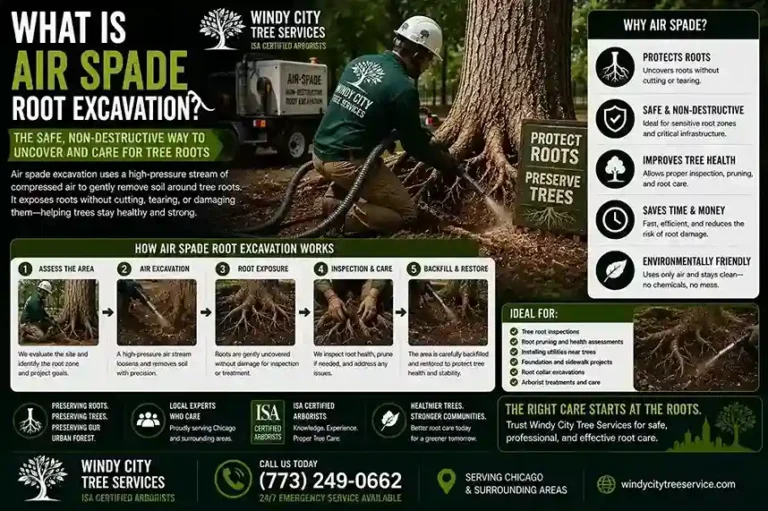
Can Air Spade Technology Help With Mature Tree Root Care?
Air Spade excavation uses a directed stream of compressed air to loosen and move soil away from roots without cutting or crushing them — a non-destructive alternative to digging with hand tools or machinery. In trained hands, it’s a genuinely valuable diagnostic and treatment tool for mature-tree root care, with applications including:
- Root-zone inspection to evaluate root health and structure directly
- Soil decompaction to restore oxygen exchange without damaging roots
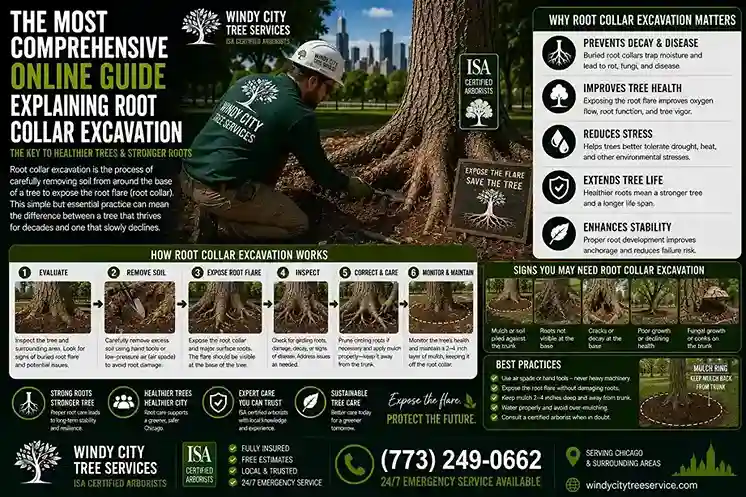
- Root collar inspection to check for girdling roots or decay at the trunk base
- Identifying buried root flares that were planted too deep or have accumulated soil over time
- Investigating root conflicts near foundations, utilities, or hardscape
Air Spade work isn’t something every mature tree needs on a routine basis — it’s most valuable when there’s a specific reason to investigate, such as suspected compaction, a buried root flare, or unexplained canopy decline. Learn more about the process on our Air Spade / root excavation service page.
Should You Water or Fertilize a Stressed Mature Tree?
This is one of the most important decisions a homeowner faces when a mature tree starts to look stressed — and getting it backward can waste time while the underlying problem continues. A simple decision framework:
- If drought stress is suspected → check soil moisture at the root zone first before assuming a nutrient problem.
- If nutrient deficiency is suspected → evaluate soil and tree condition (ideally with soil testing) before applying fertilizer.
- If root damage or compaction is suspected → investigate the root zone directly rather than treating the symptoms above ground.
- If symptoms are severe, sudden, or persistent → consult a qualified arborist rather than guessing between the options above.
Fertilizing a drought-stressed tree won’t solve a moisture problem, and watering a tree with a genuine nutrient deficiency won’t correct the underlying soil chemistry. Because the visible symptoms of these different problems overlap heavily, an accurate diagnosis is the step that actually saves time and protects the tree.
Common Deep Root Care Mistakes
- Fertilizing a tree without first identifying an actual nutrient need
- Over-fertilizing, which can burn roots and disrupt soil chemistry
- Applying fertilizer too close to the trunk instead of across the root zone
- Watering only at the base of the trunk instead of the broader root area
- Frequent, shallow watering that encourages roots to stay near the surface
- Ignoring soil compaction as a root cause of canopy decline
- Watering soil that’s already saturated or poorly drained
- Using a one-size-fits-all schedule instead of adjusting for weather and site
- Damaging roots while digging, trenching, or installing hardscape nearby
- Ignoring construction damage until the canopy visibly declines
- Assuming mature trees never need supplemental water
- Assuming fertilizer will fix every tree problem, regardless of cause
Deep Root Care for Mature vs Newly Planted Trees
Root care needs shift significantly as a tree ages. Newly planted trees are actively establishing a root system and depend heavily on consistent moisture, while mature trees have a larger, more distributed root system that changes their watering and fertilization needs.
| Factor | Newly Planted Trees | Mature Trees |
|---|---|---|
| Watering frequency | Frequent, consistent moisture during establishment (often 1–2 years) | Less frequent; supplemental deep watering mainly during drought |
| Root establishment | Actively expanding into surrounding soil | Established and distributed across a wide area |
| Soil moisture monitoring | Closer monitoring needed near the root ball | Broader root-zone monitoring, less frequent |
| Fertilizer needs | Generally minimal at planting; light fertilization if soil is deficient | Based on identified deficiency, not routine |
| Root-zone size | Small, concentrated near the original root ball | Large, extends well beyond the drip line |
| Stress response | More vulnerable to short-term drought and transplant shock | More resilient short-term, but slower to recover from major damage |
| Professional evaluation | Useful at planting and during first growing seasons | Recommended periodically throughout the tree’s life |
Homeowners often ask should I fertilize a newly planted tree — generally, minimal to no fertilizer is needed at planting unless a soil deficiency is confirmed, since young roots can be sensitive to excess salts from fertilizer. A consistent watering schedule for newly planted trees matters far more in the first one to two years than fertilization does.
How Much Does Deep Root Fertilization Cost?
There’s no universal price for deep root fertilization — cost depends on several site- and tree-specific factors, and any number quoted without an assessment should be treated as a rough placeholder rather than a firm figure. Pricing generally reflects:
- Tree size and the size of the root zone being treated
- Number of trees included in the service
- Species and any specific formulation required
- Site accessibility — tight urban lots, alleys, and fencing can affect labor
- Soil conditions, including compaction that may require additional preparation
- Whether additional diagnostic services (soil testing, Air Spade inspection) are needed
The most reliable way to get an accurate number for your property is a professional on-site assessment and written estimate rather than a generic online quote.
Can You Deep Root Feed or Water a Tree Yourself?
Homeowners can safely handle a number of root-care basics on their own:
- Monitoring soil moisture with a simple probe or screwdriver test
- Applying slow, even watering across the root zone during dry spells
- Maintaining mulch at the correct depth, pulled back from the trunk
- Avoiding damage to the trunk and root flare from mowers or trimmers
- Avoiding unnecessary digging or disturbance near the root zone
Professional help makes more sense for larger mature trees, noticeable canopy decline, known construction damage, severe or repeated drought stress, compacted soil across a wide area, a suspected nutrient deficiency, evident root damage, or recurring problems that haven’t resolved with basic care. Skip drilling, injecting fertilizer, or excavating around structural roots without professional guidance — done incorrectly, these can cause damage that outweighs any potential benefit.
Frequently Asked Questions About Deep Root Care
What is deep root care for mature trees?
Deep root care is the ongoing management of a mature tree’s root zone, including soil condition, moisture, oxygen availability, and nutrients. It may include deep watering, deep root fertilization when a need is identified, soil decompaction, mulch correction, and root inspection. It is not a single product or a one-time treatment.
Do mature trees need deep root watering?
Established trees generally need less frequent watering than newly planted trees, but many mature trees still benefit from supplemental deep watering during prolonged drought, heat waves, or in compacted urban soils where rainfall does not reach the root zone effectively.
How do you deep water a mature tree?
Apply water slowly across the root zone, roughly from the trunk out to the drip line, rather than in one spot at the base. Let it soak in fully before adding more, and check soil moisture a few inches down afterward to confirm it reached the root system instead of running off.
How often should you deep root water trees?
There is no universal schedule. Frequency depends on species, soil type, drainage, rainfall, and current weather. During dry summer stretches, many mature trees benefit from deep watering every one to two weeks; during normal rainfall, supplemental watering may not be needed at all.
Does deep root fertilization work?
Deep root fertilization can help a tree when there is a documented or likely nutrient deficiency and the treatment is matched to the tree’s actual needs. It is not a cure-all and will not fix problems caused by drought, root damage, disease, or poor site conditions.
What is the best fertilizer for mature tree roots?
There is no single best fertilizer for every tree. The right formulation and nutrient ratio depends on soil test results, species, and the specific deficiency identified. A qualified arborist selects a treatment based on assessment rather than a generic all-purpose product.
What is deep root feeding?
Deep root feeding is the placement of nutrients within the root zone, below the surface, so they reach active feeder roots more directly than a surface application. It is typically performed with professional equipment after assessing whether the tree actually needs supplemental nutrition.
What is the best time to deep root fertilize trees?
Timing depends on species, climate, and the tree’s condition. Many arborists favor early spring or fall applications tied to root growth periods, but the right timing is determined after evaluating the specific tree and its documented needs rather than a fixed calendar date.
How do you deep root fertilize trees?
Professional deep root fertilization typically follows a tree and soil assessment, identification of a nutrient need, and placement of an appropriate treatment within the root zone using specialized equipment, followed by monitoring to evaluate the tree’s response.
How much does deep root fertilization cost?
Cost varies based on tree size, number of trees, species, site accessibility, soil conditions, and the type of treatment recommended. Because pricing is site-specific, the most reliable way to get an accurate number is a professional assessment and written estimate.
Can over-fertilizing damage a tree?
Yes. Excess fertilizer can burn roots, encourage weak and excessive top growth at the expense of root development, alter soil chemistry, and in some cases contribute to runoff issues. Fertilizer should be applied based on an identified need, not on a routine schedule.
Can soil compaction affect mature tree roots?
Yes. Compacted soil reduces pore space, limits oxygen and water infiltration, and restricts root growth. It is a common issue in Chicago’s urban soils, particularly near driveways, sidewalks, parkways, and other high-traffic areas.
Can Air Spade help with mature tree root care?
Air Spade excavation uses compressed air to move soil away from roots without cutting them, which allows trained professionals to inspect root flares, evaluate compaction, and identify buried root collars or root conflicts without damaging the root system.
Do established trees need water?
Established trees can often draw on deeper, more extensive root systems than young trees, but they are not immune to drought stress. Extended dry periods, heat waves, and compacted or shallow soils can still create a real need for supplemental watering.
Should every mature tree receive deep root fertilization?
No. Fertilization should be based on an identified need, such as a confirmed nutrient deficiency or documented stress, rather than applied automatically to every mature tree. Many healthy mature trees in adequate soil do not require regular fertilization.
Key Takeaways
- Deep root care covers the whole root zone — watering, soil condition, and nutrients — not just fertilizer alone.
- Most active feeder roots live in the top 12–18 inches of soil and spread well beyond the drip line, not straight down.
- Deep watering means slow, broad application across the root zone, not a quick soak at the trunk.
- Deep root fertilization works best when it addresses a real, identified nutrient deficiency — not as a default annual treatment.
- Chicago’s compacted clay soils, pavement coverage, and seasonal drought make root-zone stress especially common in mature urban trees.
- Air Spade excavation offers a non-destructive way to inspect and improve root-zone conditions when there’s a specific reason to investigate.
- When symptoms are unclear, a professional evaluation is more reliable than guessing between watering and fertilizing.
Protect the Root System of Your Mature Trees
Mature trees represent decades of growth and a long-term investment in your property. If you’re noticing declining canopy health, drought stress, soil compaction, construction damage, or suspected nutrient problems, don’t wait for symptoms to get worse. Windy City Tree Services can evaluate your tree, root zone, soil conditions, and overall health, and recommend the right next step — whether that’s watering guidance, deep root fertilization, Air Spade decompaction, or simply peace of mind that the tree is fine as-is.