Root Collar Excavation Explained: Save Your Tree |Call 773 249-0662
Root Care · Chicago Arborist Guide
Root Collar Excavation Explained
Learn why exposing your tree’s root flare can improve health, stability, and long-term survival.
Many of the tree problems homeowners notice above ground actually start below it, buried beneath a few extra inches of soil no one thought twice about.
Introduction
A surprising number of tree problems have nothing to do with what’s happening in the canopy. They start at the base of the trunk, hidden under soil or mulch that’s been quietly accumulating for years, sometimes since the day the tree was planted.
Trees planted even a few inches too deep, or gradually buried by landscaping, grading, or an overzealous mulch bed, often develop problems that take years to show up above ground: thinning canopy, small leaves, slow growth, or an unexplained decline that doesn’t match anything visible on the trunk or branches.
Excess soil and mulch piled against the trunk can bury the natural root flare, the point where the trunk widens and transitions into the structural roots. Once buried, that area stays chronically moist and low in oxygen, conditions that set the stage for decay, girdling roots, and long-term decline.
Root collar excavation lets arborists safely remove that excess material, inspect what’s actually happening at the base of the tree, and correct problems before they become irreversible. By the end of this guide, you’ll understand what root collar excavation is, why it matters, when it’s recommended, and how professionals perform it safely using Air Spade technology.
Root collar excavation (RCX) is a professional arboricultural procedure that removes excess soil and mulch from around the base of a tree to expose the natural root flare. Performed with an Air Spade or other non-destructive methods, it helps identify buried root collars, girdling roots, root decay, and planting-depth problems, and should always be carried out by trained professionals rather than homeowners.
1. What Is the Root Collar?
- Root collar definition: The transition zone at the base of the trunk where it widens and connects to the tree’s structural roots.
- Root flare anatomy: The visible, flaring widening of the trunk just above ground level, where bark texture typically shifts and major roots begin spreading outward.
- Transition between trunk and roots: This zone functions differently from the rest of the trunk; the tissue here isn’t adapted to prolonged burial the way roots are.
- Why the root flare should be visible: A properly planted, healthy tree shows this flare at soil level, not buried beneath mulch or fill dirt. Its visibility is one of the simplest field indicators of proper planting depth.
2. What Is Root Collar Excavation?
- Purpose: To expose the root flare and structural roots for inspection, diagnosis, and correction of buried-collar problems.
- Process: Careful removal of soil and mulch around the base of the trunk down to the natural root flare and major structural roots.
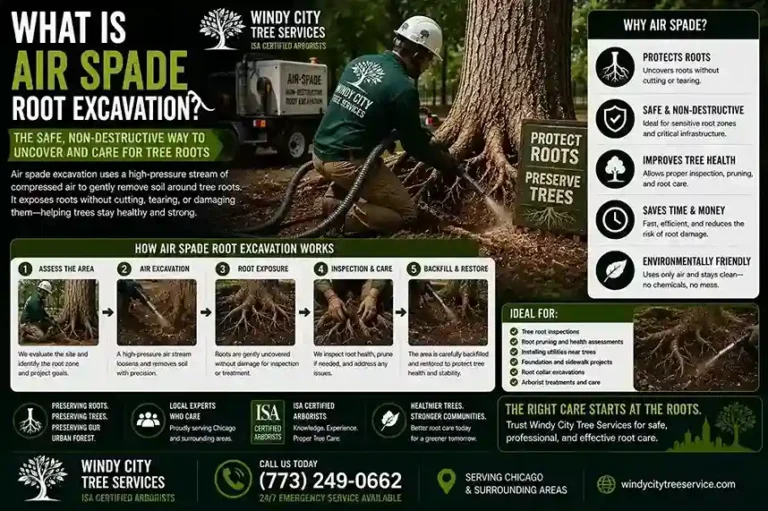
- Air Spade technology: Compressed air excavation tools remove soil without cutting or crushing roots, unlike shovels or mechanical digging.
- Soil removal: Excess material is cleared away and, depending on the site, either removed or redistributed away from the trunk.
- Inspection: Once exposed, the arborist examines the flare and roots directly for girdling roots, decay, or structural problems.
- Follow-up treatments: Depending on findings, this may include girdling root removal, decay treatment, or ongoing monitoring.
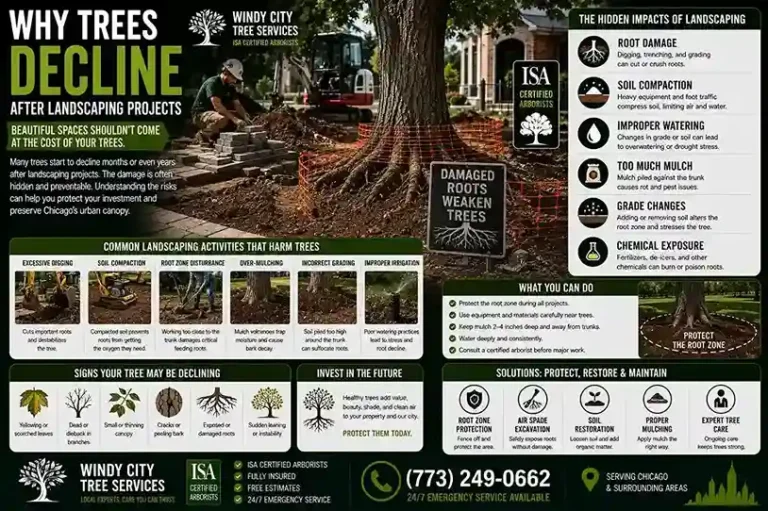
3. Why Trees Develop Buried Root Collars
- Planting too deep: One of the most common causes; nursery stock or new plantings set even a few inches below the correct depth start with a buried flare from day one.
- Excess mulch (“mulch volcanoes”): Mulch piled directly against the trunk, rather than spread in a wide, shallow ring, gradually buries the flare over successive seasons.
- Soil grading: Adding soil around an established tree during landscaping changes can raise the grade enough to bury the collar.
- Landscape renovations: New beds, retaining walls, or regrading projects often unintentionally raise soil levels near existing trees.
- Construction: Fill dirt brought in during nearby construction frequently ends up piled against established trees.
- Natural soil accumulation: Over decades, windblown soil, leaf litter, and organic buildup can gradually raise grade around a trunk even without any human intervention.
4. Problems Caused by Buried Root Flares
- Girdling roots: Roots forced to grow at an angle around the trunk instead of outward, gradually strangling it as both grow in diameter.
- Root decay: Chronic moisture at a buried flare creates ideal conditions for decay-causing organisms.
- Trunk rot: Bark tissue that isn’t adapted to constant soil contact can break down, allowing decay into the trunk itself.
- Reduced oxygen: Buried tissue and compacted soil both limit the oxygen exchange roots and the root collar need to function properly.
- Moisture retention: Soil and mulch held against the trunk keeps bark persistently damp, well beyond what it’s built to tolerate.
- Pest infestations: Damp, decaying tissue at the base attracts insects and creates entry points for secondary infestations.
- Declining tree health: All of the above compound over time, often presenting as a slow, hard-to-diagnose decline rather than a single obvious symptom.
Why This Gets Missed
Because buried root collar problems develop underground and progress slowly, they’re frequently misdiagnosed as unrelated issues, drought stress, nutrient deficiency, or general “old tree decline,” when the actual root cause (literally) has been sitting a few inches below the surface the whole time.
5. Signs Your Tree May Need Root Collar Excavation
- No visible root flare at the base of the trunk
- A trunk that goes straight into the ground like a telephone pole, without any widening
- Thin, sparse canopy relative to the tree’s size and species
- Smaller-than-normal leaves
- Slow or stunted growth compared to similar trees nearby
- Premature fall color, appearing weeks ahead of neighboring trees
- Mushrooms growing near the base of the trunk
- Bark deterioration or discoloration near the soil line
- Dieback in the upper canopy with no other obvious cause
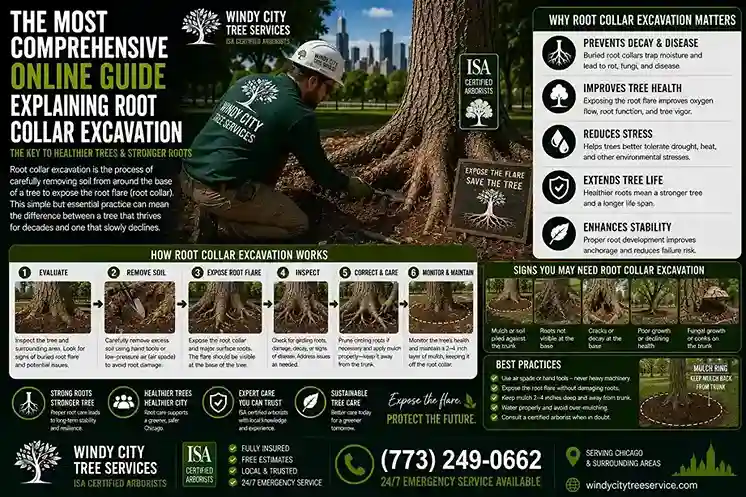
6. How Arborists Perform Root Collar Excavation
Initial inspection
Assessing the tree’s overall condition and confirming RCX is the appropriate diagnostic step.
Air Spade excavation
Using compressed air to carefully remove soil without damaging roots or bark.
Root cleaning
Clearing debris and loose soil from around exposed structural roots.
Girdling root evaluation
Identifying any roots circling or pressing against the trunk.
Root flare exposure
Fully revealing the natural flare and its transition into the trunk.
Post-excavation assessment
Documenting findings and determining what follow-up treatment, if any, is needed.
Safety precautions
Following established digging and utility-locating protocols throughout the process.
7. The Role of Air Spade Technology
- Compressed air: High-velocity air breaks apart soil without the cutting force of a shovel or mechanical digger.
- Precision excavation: Operators can work carefully around individual roots rather than digging blindly through them.
- Non-destructive process: Roots that would be severed by traditional digging are typically left intact and undamaged.
- Root preservation: This precision is exactly why Air Spade work is considered a preservation tool, not just an excavation method.
- Soil decompaction: The same technology can loosen compacted soil around the root zone, improving oxygen and water infiltration beyond just flare exposure.
The Tree Care Industry Association and ISA both recognize Air Spade excavation as a standard, evidence-based method for root zone work precisely because it minimizes the root damage that comes with traditional digging.
8. Can Root Collar Excavation Improve Tree Health?
- Better oxygen exchange: Exposing the flare restores normal gas exchange at the root collar.
- Improved drainage: Removing soil buildup reduces the chronic moisture that promotes decay.
- Reduced trunk moisture: Bark at the base can dry properly instead of staying persistently damp.
- Enhanced inspections: A visible flare makes future health checks faster and more accurate.
- Long-term monitoring: RCX often becomes the starting point for an ongoing care plan rather than a one-time fix.
How much improvement to expect depends heavily on how long the flare was buried and how much damage, like decay or girdling, had already occurred. Trees caught early tend to respond better than those with years of accumulated damage.
9. Trees That Commonly Benefit from RCX
| Species | Why RCX Often Helps |
|---|---|
| Oak | Sensitive to root zone disturbance and prone to decline from buried flares |
| Maple | Common victim of mulch volcanoes and shallow planting depth issues |
| Elm | Root collar health directly affects resistance to secondary stress and disease |
| Ash | Already vulnerable to Emerald Ash Borer; a healthy root collar supports overall resilience |
| Honey Locust | Frequently planted too deep in urban and new-construction settings |
| Birch | Thin bark makes it especially sensitive to chronic moisture at the base |
| Spruce | Shallow root systems are particularly affected by soil buildup at the collar |
| Pine | Can decline slowly from buried flares without obvious early symptoms |
| Ornamental trees | Often planted in landscaped beds where mulch depth is hardest to control |
10. Root Collar Excavation vs. Root Pruning
These are related but distinct procedures. Root collar excavation exposes the flare for inspection and correction of burial-related problems. Root pruning, by contrast, involves selectively cutting specific roots, often to address girdling roots discovered during excavation, or to manage roots interfering with nearby structures or hardscape.
In practice, RCX often comes first: it’s the diagnostic step that reveals whether root pruning is actually needed, and exactly where. Performing root pruning without first exposing the root zone risks cutting the wrong roots or missing others that need attention.
11. When Tree Removal May Be Necessary
Root collar excavation is a preservation-focused procedure, but it isn’t always enough to save a tree. Removal may become the safer option when excavation reveals:
- Severe decay that has already compromised a large portion of the root collar or lower trunk
- Extensive girdling affecting most of the root system, beyond what selective pruning can correct
- Structural instability that puts the tree at meaningful risk of failure regardless of treatment
- Advanced decline where the canopy and root system show damage beyond a realistic recovery threshold
- Safety concerns for a tree near a home, driveway, or high-traffic area where the risk profile outweighs preservation efforts
These decisions should follow a full professional risk assessment, not just the excavation findings alone. If you’re weighing this decision, our guide on When Should a Tree Be Removed? covers the broader decision-making process.
Did You Know?
The Morton Arboretum and University of Illinois Extension both cite improper planting depth as one of the most common, and most preventable, causes of long-term tree decline in landscaped settings, which is part of why RCX has become a standard diagnostic tool in modern arboriculture.
Healthy Root Flare vs. Buried Root Collar
| Healthy Root Flare | Buried Root Collar | |
|---|---|---|
| Visibility | Root flare visible at soil level | Trunk disappears straight into soil |
| Bark condition | Dry, healthy bark texture | Constant moisture against bark |
| Oxygen exchange | Good oxygen flow at the collar | Oxygen restriction from soil coverage |
| Root structure | Strong, outward-spreading structural roots | Hidden girdling roots possible |
| Long-term outlook | Better long-term stability | Increased risk of decline |
Root Collar Excavation vs. Traditional Digging
| Root Collar Excavation | Traditional Digging | |
|---|---|---|
| Method | Air Spade excavation | Shovel or machinery |
| Root impact | Reduced root injury | Greater chance of root damage |
| Control | Precise root exposure | Less control around root structure |
| Purpose | Diagnostic procedure | General excavation |
| Focus | Tree preservation focused | Construction focused |
Homeowner Checklist: Signs Your Tree Needs a Root Collar Inspection
- Root flare isn’t visible at the base of the trunk.
- Excess mulch is piled directly against the trunk.
- Soil appears piled or mounded around the base of the tree.
- The tree shows slow or stunted growth.
- Leaves appear yellow or undersized.
- Mushrooms are growing near the trunk.
- The canopy is thinning or declining without clear cause.
- Recent construction has occurred near the tree.
- The area around the tree drains poorly.
- Surface roots appear to circle rather than spread outward.
Frequently Asked Questions
A professional procedure that removes excess soil and mulch from around the base of a tree, using an Air Spade or similar non-destructive method, to expose the natural root flare for inspection and treatment.
The root flare needs exposure to air, not constant soil contact. When buried, it stays chronically moist and low in oxygen, conditions that promote decay and girdling root problems.
Many do for years, but often with slow, progressive decline. The longer a flare stays buried, the more likely lasting damage becomes.
Roots that grow at an angle around the trunk instead of spreading outward, gradually constricting the trunk as both grow in diameter over time.
Generally no. Compressed air breaks apart soil without the cutting force of a shovel or machinery, which is why it’s the preferred method for root-sensitive excavation work.
Most residential RCX projects take a few hours, depending on tree size, soil depth, and how much material needs to be removed.
Cost varies by tree size and site conditions. Request a free estimate for pricing specific to your property; it’s generally far less expensive than eventual removal of a tree lost to preventable decline.
Light mulch adjustment is fine for homeowners, but deeper excavation risks damaging roots without proper equipment and training. Air Spade work should be left to trained professionals.
Oaks, maples, and other species commonly affected by mulch volcanoes or planting-depth issues tend to see the clearest benefit, though any species with a buried flare can be affected.
If the root flare isn’t visible, if the tree shows unexplained decline, or after any construction or landscaping work that changed soil grade near the tree.
Most commonly, planting too deep from the start, excess mulch piled against the trunk, or soil added during landscaping or construction near an established tree.
Sometimes, particularly if caught before extensive decay or girdling has occurred. Trees with advanced damage may see limited improvement even after excavation.
Not when applied correctly. A wide, shallow ring of mulch away from direct trunk contact is beneficial. Mulch piled against the trunk, sometimes called a “mulch volcano,” is the problem.
Generally 2 to 4 inches deep, spread in a wide ring, and kept a few inches away from direct contact with the trunk.
Yes. Removing excess soil and, where appropriate, decompacting the surrounding area both improve water movement away from the root collar.
Typically the flare and upper structural roots remain at a natural, appropriate depth once excavated correctly, rather than being left fully exposed above grade.
Yes. Grading changes and fill dirt brought in during construction are common causes of buried flares on established trees near a job site.
The excavation itself is typically a one-time correction, though ongoing monitoring and proper mulch management help prevent the problem from recurring.
Air Spade is the tool; root collar excavation is one common application of it, specifically focused on exposing the base of the trunk rather than general root zone investigation.
Key Takeaways
- The root flare needs to stay visible at soil level; burial from mulch, soil, or grading changes creates long-term problems.
- Buried root collars cause chronic moisture, reduced oxygen, and conditions that favor decay and girdling roots.
- Root collar excavation uses Air Spade technology to expose the flare without damaging roots, unlike traditional digging.
- RCX is a diagnostic and corrective procedure, best performed by trained professionals rather than homeowners.
- Catching a buried flare early gives a tree meaningfully better odds than addressing it after years of accumulated damage.
- Severe decay or extensive girdling discovered during excavation may still point toward removal rather than preservation.
Learn more from our Chicago Tree Service homepage and meet our ISA Certified Arborists, our Tree Preservation Experts. Related services include Air Spade root excavation, tree health inspections, tree & shrub fertilization, tree trimming & pruning, tree removal, tree cabling & bracing, storm prep & support systems, and emergency tree removal.