
Tree Service in Jackson Park Highlands, Chicago
Certified arborists trusted by homeowners in Chicago’s 1905 landmark district for careful removal, structural pruning, and long-term preservation of century-old oaks and elms on some of the South Side’s largest residential lots.
Tree Care Built for a Landmark District
Jackson Park Highlands sits inside the South Shore community area, but it doesn’t look or feel like a typical Chicago block. Laid out in 1905, the district was designed from the start with 50-foot-wide lots, deep front yard setbacks, underground utilities, and no alleys, features that were unusual for their time and remain rare in Chicago today. The Commission on Chicago Landmarks designated the neighborhood a Chicago Landmark on October 25, 1989, protecting its collection of American Foursquare, Classical Revival, Queen Anne, Dutch Colonial, Colonial Revival, Tudor, and Prairie School homes.
That planning history is why the tree canopy here reads differently than in most South Side neighborhoods. Wide setbacks meant room for large shade trees to mature undisturbed for well over a century, and the absence of alleys means those trees, along with their root systems, often extend closer to foundations, sidewalks, and underground utility lines than a homeowner might expect. We treat every job here the way we’d treat work in Hyde Park to the north or Beverly to the southwest, the two other South Side neighborhoods most often compared to Jackson Park Highlands: with equipment and planning suited to legacy trees on landmark property, not a one-size-fits-all removal job.
The district sits directly against the Jackson Park Golf Course on its north edge, part of the larger 550-acre Jackson Park that hosted the 1893 World’s Columbian Exposition and is now home to the Obama Presidential Center. The former Illinois Central Electric right-of-way, now the Metra Electric line, runs along the south edge. Homeowners here are a short walk from Lake Michigan, the South Shore Cultural Center, and the Museum of Science and Industry, all of which shapes both the wind exposure our arborists plan around and the property values that make careful, documented tree work worth the extra planning.
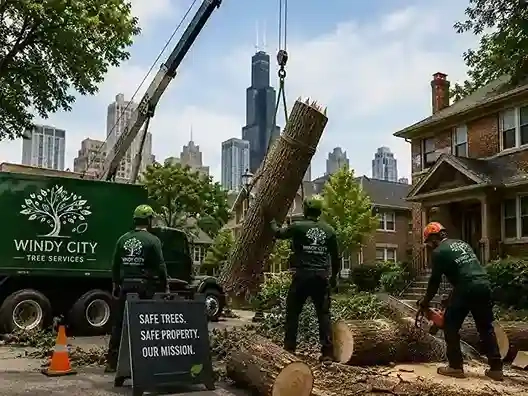
Work Suited to a Neighborhood With No Alleys and Underground Utilities
Two features set Jackson Park Highlands apart from almost every other Chicago neighborhood on our route: there are no alleys, and utilities run underground rather than overhead. Both change how a tree job gets planned and staged.
Street-Side Staging
With no alley access anywhere in the district, every chipper, bucket truck, and debris haul works from the street. We plan parking, parkway protection, and cleanup routes around this before the crew arrives.
Air Spade Root Excavation
Compressed air exposes root systems around century-old trees without cutting roots or risking contact with the neighborhood’s underground electric, gas, and water lines.
Structural Pruning
We prune mature bur oaks and elms to reduce weight on weak unions and correct structural defects that build up over a century, extending the safe life of trees older than the homes around them.
Cabling & Bracing
Steel support systems reinforce co-dominant limbs and heavy canopy sections on legacy trees, the preferred approach for homeowners who want to preserve a landmark-era specimen rather than remove it.
Large-Lot Assessments
Fifty-foot lots and deep setbacks mean more mature trees per property than a typical city lot. We assess the full front, side, and rear canopy, not just the tree you called about.
Foundation-Safe Removal
Century-old root systems can run under sidewalks, driveways, and foundations built before modern construction standards. We plan removals to avoid unnecessary disturbance to what’s underground.
How Chicago Weather Affects Jackson Park Highlands Trees
Jackson Park Highlands sits close enough to Lake Michigan that lakefront wind plays a real role in tree health here, similar to the pattern we see along the lakefront blocks of Hyde Park to the north. Wind exposure along the district’s eastern edge, closest to the golf course and the lake, pushes root systems to develop unevenly and adds stress to any tree already carrying decay or a co-dominant stem.
Winter brings heavy, wet snow that loads down limbs already weakened by summer storms, and spring thunderstorms roll through with wind gusts strong enough to snap dead or poorly pruned branches with little warning. Because the district’s mature trees are older and larger on average than trees in newer South Side developments, storm failures here tend to be bigger events, closer to century-old homes with irreplaceable architectural detail.
That combination is exactly why we recommend proactive care over reactive removal calls in this neighborhood. Preventive pruning before winter, a structural check after any major storm, and dormant-season maintenance protect landmark homes, the golf course fence line, and pedestrians walking the district’s wide, tree-lined streets.
Tree Species Common Throughout Jackson Park Highlands
A century of undisturbed growth on generous setbacks has produced one of the largest concentrations of mature shade trees on the South Side.
| Species | Where It’s Common | Watch For |
|---|---|---|
| Bur Oak & White Oak | Front lawns and deep setback yards throughout the district | Oak wilt, storm-damaged limbs |
| Red Oak & Northern Red Oak | Larger corner lots near Cregier and Euclid Avenues | Oak wilt spread through connected root systems |
| American Elm | Original 1905-era streetscape plantings | Dutch elm disease |
| Sugar Maple | Side and rear yards on interior blocks | Drought stress, girdling roots |
| Honey Locust | Newer plantings replacing lost elms and ash | Compacted soil near driveways |
| Hackberry | Interior residential lots | Witches’ broom, minor structural issues |
| Linden & Crabapple | Ornamental front yard plantings | Pruning for shape, minor pest pressure |
The two issues we field the most calls about here are oak wilt in the district’s older oaks and storm damage to large limbs weakened by age or prior poor pruning. Because lots sit close together with unbroken canopy running from yard to yard, an infected or hazardous tree on one property can put a neighbor’s tree at risk quickly. Catching problems early with a health inspection, rather than waiting for a failure, is almost always the better outcome for both the tree and the home beneath it.
Landmark Homes, Large Lots & Neighborhood Common Areas
Jackson Park Highlands is almost entirely residential, but the property mix within that is more varied than it looks from the street.
Landmark Foursquare Homes
Careful removal and pruning around original 1905-era construction and masonry.
Tudor & Colonial Revival Estates
Preservation-focused work for the district’s larger historic residences.
Prairie School Residences
Tree care planned around the horizontal lines and low rooflines typical of the style.
Deep Corner Lots
Assessments covering the full canopy on 50-foot-wide, multi-tree properties.
New Construction on Historic Lots
Root protection planning for legacy trees during renovation or infill building projects.
Neighborhood Association Coordination
Parkway and common-area tree care coordinated with the local block club.
Golf Course Boundary Properties
Removal and trimming near the fence line shared with Jackson Park Golf Course.
Residential Homeowners
Free estimates and honest recommendations for every block in the district.
Parks and Parkways That Define Jackson Park Highlands
Jackson Park and its golf course border the district on the north, giving the neighborhood a green, open edge that few South Side communities share. To the east and south, the district connects to South Shore, with Lake Michigan, Rainbow Beach, and the South Shore Cultural Center all within easy reach. The Obama Presidential Center, now under construction in Jackson Park, sits close enough to influence pedestrian traffic and property attention along the district’s northern streets.
Inside the district itself, the tree canopy running along Constance, Bennett, Euclid, and Jeffery Avenues does more than frame the architecture. A mature, unbroken canopy over wide parkways cuts summer cooling costs, slows stormwater runoff, and softens the visual transition between the historic homes and the golf course beyond. Preserving that canopy, tree by tree, is part of what keeps the district’s landmark character intact for the next generation of homeowners.
Driving Directions
Our crews regularly service Jackson Park Highlands and the surrounding South Shore area. Here’s how our team typically approaches the neighborhood.
- 🚗From Lake Shore Drive: Exit at 67th Street or 71st Street and head west into the district, with Jackson Park Golf Course on your right.
- 🛣️From I-90/94 (Dan Ryan Expressway): Exit at 71st Street and head east through South Shore toward Jeffery Boulevard.
- 🌳From Hyde Park: Head south on Stony Island Avenue or South Shore Drive, past the Museum of Science and Industry, to 67th Street.
- 🚦Along Jeffery Boulevard: This is the district’s eastern boundary, connecting Jackson Park Highlands to the South Shore Cultural Center and Rainbow Beach.
- 🚉From the Metra Electric Line: The 67th Street and 71st/South Shore stations sit at the district’s north and south edges, running along the former Illinois Central right-of-way.
- ⛳From Jackson Park Golf Course: The course forms the district’s entire northern boundary, with residential blocks extending south to 71st Street.
Tree Services Available in Jackson Park Highlands
Every service below is available throughout the district and surrounding South Shore blocks, with the same certified crews and equipment used across all of Chicago.
🌲 Tree Removal
Safe removal of dead, diseased, or hazardous trees on landmark and residential lots.
Tree removal in Jackson Park Highlands →⚡ Emergency Tree Removal
24/7 response for storm-downed limbs blocking driveways or resting on structures.
Emergency tree removal →✂️ Tree Trimming & Pruning
Structural pruning that follows ANSI A300 standards for century-old shade trees.
Tree trimming in Jackson Park Highlands →🔘 Stump Grinding & Removal
Grinding 6 to 8 inches below grade so you can replant or resurface without obstruction.
Stump grinding →🔗 Tree Cabling & Bracing
Structural support systems that preserve legacy trees rather than removing them.
Cabling and bracing →🔍 Tree Health Inspection & Treatment
Early diagnosis of oak wilt and Dutch elm disease before it spreads between lots.
Tree health inspection →🌿 Tree & Shrub Fertilization
Deep-root fertilization for mature trees on the district’s compacted urban soil.
Fertilization services →💨 Air Spade
Root collar excavation without damaging roots near underground utility lines.
Air Spade service →🚜 Land Clearing
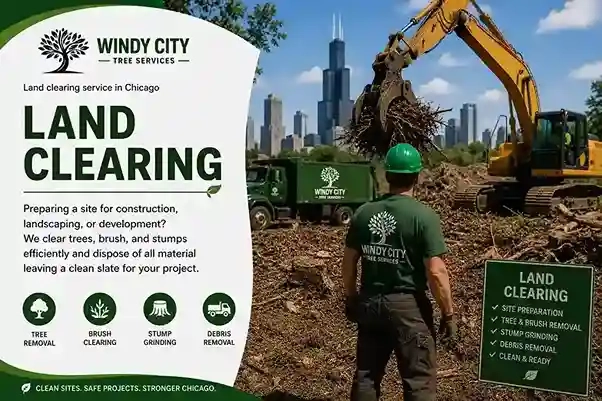
Site preparation for renovation or new construction on landmark district lots.
Land clearing →🏢 Commercial Tree Service
Scheduled maintenance for the neighborhood association and shared common areas.
Commercial tree service →🌩️ Storm Prep & Support Systems
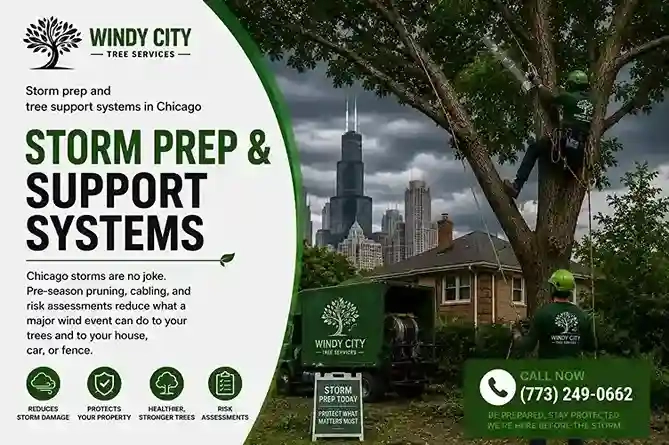
Pre-season pruning and risk assessments that reduce storm damage before it happens.
Storm prep →🪵 Firewood & Wood Chip Supply
Seasoned firewood and fresh wood chips sourced from local Chicago removal jobs.
Firewood delivery →Why Choose Windy City Tree Services
Licensed & Insured
Full liability and workers’ comp coverage, with certificates provided before work starts.
Experienced Arborists
ISA-certified arborists who understand tree biology, not just removal.
Modern Equipment
Aerial lifts, cranes, and precision rigging suited to deep setback lots and street-only access.
Landmark District Experience
Familiarity with the preservation priorities that come with a designated Chicago Landmark.
No-Alley Planning
Every job staged from the street, with parkway and driveway protection built into the plan.
Emergency Response
24/7 dispatch for storm damage, answered by a real person, not a voicemail.
Complete Cleanup
Every branch and wood chip hauled away or handled per your preference before we leave.
Local Knowledge
Two decades of hands-on experience with the South Side’s soil, species, and permitting rules.
Frequently Asked Questions About Tree Service in Jackson Park Highlands
Do I need a permit to remove a tree in Jackson Park Highlands?
Trees on the public parkway, the strip between the sidewalk and street, require a City of Chicago permit before removal. Trees on private property generally do not need one. Jackson Park Highlands is a designated Chicago Landmark district, and that status governs building exteriors rather than private trees, but we still confirm requirements as part of every estimate.
Does the neighborhood having no alleys change how tree work gets done?
Yes. Jackson Park Highlands was built without alley access, so every crew, chipper, and debris haul happens from the street side of the property. We plan staging and equipment placement around this from the first site visit so driveways, parkways, and neighboring yards stay clear during the job.
Can you excavate around tree roots without disturbing the underground utilities here?
Yes. The district was one of the first in Chicago built with underground utility lines, so we use Air Spade excavation, which clears soil with compressed air instead of a shovel or trencher, to expose roots without risking contact with buried electric, gas, or water lines.
Do you offer 24/7 emergency tree removal in Jackson Park Highlands?
Yes. Storm damage and fallen limbs do not wait for business hours, and neither do we. Call (773) 249-0662 any time and a crew will be dispatched to secure the hazard.
Can you preserve a century-old tree on a historic lot instead of removing it?
In most cases, yes. Structural pruning, cabling, bracing, and Air Spade root work can extend the life of a legacy oak or elm that predates the home around it, without requiring removal.
How much does tree removal cost in Jackson Park Highlands?
Cost depends on the tree’s size, condition, and how close it sits to a home, garage, or neighboring property. Large corner lots and deep setbacks in this neighborhood often mean more room to work, which can lower cost compared with a tighter city lot. We provide a free written estimate after an in-person site visit.
Do you work with the Jackson Park Highlands neighborhood association?
Yes. We coordinate with block clubs, the neighborhood association, and individual homeowners on parkway tree care, storm cleanup, and preservation projects that affect the district’s tree-lined streetscape.
What tree species are most common in Jackson Park Highlands?
Mature bur oak, red oak, American elm, sugar maple, honey locust, and hackberry are common throughout the district’s large front lawns, along with ornamental crabapple and linden on smaller lots.
Is oak wilt a concern for trees in Jackson Park Highlands?
Yes. The district’s mature oak canopy is vulnerable to oak wilt, which spreads through connected root systems and can move between neighboring lots quickly since the wide, unbroken front lawns here often sit close together. We recommend avoiding oak pruning between April and July and scheduling an inspection at the first sign of leaf wilt.
Do you remove trees close to a home near Jackson Park golf course?
Yes. We use rigging, aerial lifts, and sectional dismantling to bring trees down in controlled pieces near homes, fences, and property lines along the golf course edge of the district.
Are your estimates free for Jackson Park Highlands homeowners?
Always. Every estimate is free, written, and provided after an in-person site visit, with no obligation to book any work.
What is the best time of year to prune trees in Jackson Park Highlands?
Late winter, roughly February through early March, is ideal for most species since trees are dormant. Oak pruning should be scheduled outside the April through July window to reduce the risk of attracting oak wilt beetles.
Do you handle storm cleanup near the lakefront edge of the district?
Yes. The district sits close enough to Lake Michigan that wind off the lake adds extra stress to large canopy trees. Our 24/7 emergency crews respond to storm-damaged limbs and downed trees throughout Jackson Park Highlands and the surrounding South Shore area.
Do you provide stump grinding in Jackson Park Highlands?
Yes. We grind stumps 6 to 8 inches below grade so the site is ready for new sod, landscaping, or paving, and we can leave the resulting wood chips or haul them away.
How quickly can you respond to a tree emergency in Jackson Park Highlands?
Our dispatch sends the nearest available crew, and the neighborhood’s South Side location keeps it well within our regular emergency response routes.
Tree Service Near Jackson Park Highlands
We also serve the neighborhoods surrounding Jackson Park Highlands as part of our South Side Chicago tree service coverage, with the same certified crews and response times.
Looking for tree care elsewhere in the city? Visit our Chicago service area hub to find your neighborhood, or head back to our tree service Chicago homepage for a full overview of what we offer as your local expert tree care team.
Ready for a Free Tree Service Estimate in Jackson Park Highlands?
Whether it’s a single legacy oak on a deep setback lot or full canopy care for a landmark home, we’ll give you an honest assessment and a fair, written price. No pressure, just experienced advice from arborists who know this district.
info@windycitytreeservices.com · 323 W Carroll Ave, Chicago, IL 60612 · Licensed, Insured & Available 24/7