
Tree Service in South Deering, Chicago
Certified arborists, heavy equipment, and 24/7 storm response for the homes, warehouses, and institutions that make up South Deering, from the bungalow blocks near Torrence Avenue to the industrial yards along the Calumet River.
A Neighborhood Built on Steel, Rail, and the Calumet River
South Deering grew up around industry. In the late 1800s, steel mills and rolling mills settled along the Calumet River, and the neighborhood took shape to house the workers who ran them. Wisconsin Steel operated here for generations, and the rail lines that once carried raw material into the mills still cross the neighborhood today, tying South Deering into the wider Far South Chicago freight network.
That industrial backbone never really left. Warehouses, logistics yards, and manufacturing plants still line the streets near Torrence Avenue, sitting close to the bungalows and two-flats where South Deering families have lived for decades. It’s an unusual mix for Chicago: quiet residential blocks a few minutes from active rail spurs and loading docks.
South Deering also sits closer to open water than most Chicago neighborhoods. The Calumet River corridor cuts through the community on its way to Lake Michigan, and Lake Calumet sits just to the west. That waterway shaped the neighborhood’s early economy, its soil, and how storms move through the area today.
Between the industrial parcels and residential streets, South Deering holds onto some of the largest green spaces on Chicago’s Far South Side, including Big Marsh Park and the William W. Powers State Recreation Area. Keeping trees healthy here means understanding three very different property types at once: family homes, working industrial sites, and public parkland, often within a few blocks of each other.
Windy City Tree Services works across all three settings. That means an arborist who can prune a parkway tree in front of a South Deering bungalow in the morning and inspect root systems around a logistics facility’s loading dock that same afternoon, without treating either job as an afterthought. See how we cover the wider Far South Chicago tree service region, or browse our full Chicago tree service locations to see how South Deering fits into our coverage map.
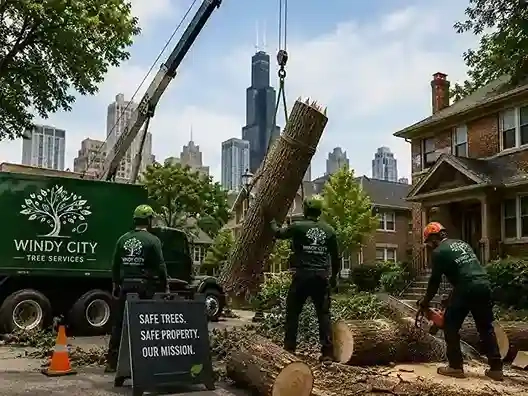
South Deering’s Urban Forest: What’s Growing Here and Why It Matters
South Deering’s tree canopy reflects its split identity. Along residential streets, mature bur oaks, silver maples, and cottonwoods shade bungalow lots that have held the same trees for 60 years or more. Willows and cottonwoods cluster naturally near the wetter ground along the Calumet River and around Lake Calumet, where their root systems tolerate periodic flooding that drier species cannot handle. American elm and green ash still stand in scattered pockets, though both species face serious disease pressure covered in more detail below.
Inside Big Marsh Park and Calumet Park, tree plantings support a different mission: habitat restoration and shade for trails, picnic areas, and the wetlands the Chicago Park District has worked to rebuild over the past decade. These park trees need long-term canopy management rather than quick fixes, since they anchor the landscape for generations.
Industrial and commercial parcels along Torrence Avenue and the rail corridors present a third category entirely. Screening trees and buffer plantings around warehouses and logistics yards do real work: they block wind, soften sightlines from residential blocks, and cut down on dust. But they also grow in compacted soil, close to pavement and underground utilities, which creates root problems that residential trees rarely face.
That’s where advanced arboriculture earns its keep. Air Spade root excavation lets us expose roots with compressed air instead of a shovel, so we can inspect the root collar, correct girdling roots, or work near utility lines without cutting through healthy root tissue. A root collar inspection tells us whether a tree is struggling because of soil grade problems, mulch piled too high against the trunk, or early decay, often before symptoms show up in the canopy. For trees with structural weaknesses, cabling and bracing redistributes the load across weak unions and heavy limbs, extending the life of a valuable oak or maple instead of removing it outright. And when construction or site development is planned near existing trees, protective fencing around root zones, adjusted grading plans, and soil compaction monitoring keep mature trees alive through a project that could otherwise kill them.
None of this is optional in a neighborhood like South Deering. Healthy trees cool residential blocks that sit close to industrial heat sources, filter air near rail yards and warehouses, hold soil in place along the Calumet River’s banks, and give wildlife a place to live in a neighborhood that’s otherwise dense with pavement and rail infrastructure. A well-maintained canopy is also good for property values, whether that property is a single-family home or a logistics facility.
How Chicago Weather Shapes Tree Care in South Deering
Trees in South Deering deal with a specific mix of stress that comes from sitting close to Lake Michigan and Lake Calumet at once. Wind off the lake picks up speed as it crosses open water and marshland, then hits the neighborhood with less to slow it down than a denser inland block would have. That makes storm damage more likely here than in some other Chicago neighborhoods, especially for trees with existing structural weaknesses.
Winter brings heavy snow loads and ice storms that stress limbs already weakened by decay or poor pruning history. Spring and summer bring strong thunderstorms, sometimes with straight-line winds, that can snap large limbs or take down entire trees with shallow or compromised root systems. Summer heat, meanwhile, stresses trees growing in the compacted soil typical of industrial parcels, since packed ground holds less water and oxygen for roots to use.
Flooding is a real concern too. Low-lying ground near the Calumet River and Lake Calumet can stay saturated for days after a heavy rain, and trees that sit in standing water for extended periods often show root damage months later, sometimes as canopy dieback the following summer.
The response to all of this is proactive, not reactive. Seasonal pruning during late winter dormancy removes weak limbs before storm season arrives. Preventive inspections catch decay, cracks, and root problems before they turn into emergencies. For industrial and commercial properties along the rail corridors, storm preparation matters even more, since a fallen tree near a warehouse loading dock or a rail spur can shut down operations, not just damage landscaping. Our storm prep and support systems service is built around exactly this kind of risk.
Tree Species Common to South Deering, and the Problems We See Most
South Deering’s tree population includes a broad mix of species, each with its own strengths and vulnerabilities depending on where it grows in the neighborhood.
Problems We See Most Often in South Deering
Emerald Ash Borer
Has devastated green ash populations across Chicago, and South Deering is no exception. Once a tree shows canopy thinning and bark splitting, treatment options narrow fast.
Oak Wilt
Spreads through root grafts between nearby oaks and through beetles that carry the fungus to fresh wounds, which is why we avoid pruning oaks during the growing season.
Dutch Elm Disease
Still claims the neighborhood’s remaining American elms, usually showing up as sudden wilting in one section of the canopy first.
Root Compaction
Common around industrial parcels and parking areas, where heavy equipment and vehicle traffic pack soil down until roots can’t get enough oxygen.
Salt Damage
From winter de-icing along Torrence Avenue and other main roads, which burns roots and leaf margins on trees planted too close to the curb.
Storm Damage
Driven by the lake wind, ice, and thunderstorm patterns common to this part of the Far South Side.
Large Limb Failure
Often the result of included bark at a weak union, invisible until the limb actually splits.
Decay
Internal decay can hollow out a trunk or major limb long before any external symptoms appear.
Flood Stress
From standing water near the Calumet River and Lake Calumet after heavy rain events.
Aging Trees
Many of South Deering’s largest trees are 50 to 80 years old, the stage where structural problems become more common and require professional judgment.
Tree Service for Every Property Type in South Deering
South Deering asks more of a tree service company than most neighborhoods, simply because of how many different property types sit within its borders.
Single-family homes and bungalows make up most of the residential streets, where routine trimming, storm cleanup, and stump grinding are the most common calls. Apartment buildings and multi-flats need similar care, often coordinated with property managers rather than individual owners.
Churches and schools carry extra responsibility. A dead limb over a playground or parking lot isn’t only a landscaping issue, it’s a liability question, and we handle those inspections with that in mind.
Industrial facilities, warehouses, manufacturing plants, and logistics centers are where South Deering’s tree work looks most different from a typical residential job. Trees here often screen truck yards from residential blocks, grow in compacted or disturbed soil, and sit close to rail lines, fencing, and underground utilities. Maintenance on these properties usually means larger-scale trimming, hazard tree removal near loading areas, and land clearing for expansion projects, work that has to account for active operations and safety protocols a homeowner’s yard never requires.
Commercial buildings, municipal properties, and vacant land round out the mix, each with its own maintenance rhythm. For property management companies overseeing several South Deering addresses at once, we offer scheduled maintenance programs through our commercial tree service that keep every property on the same inspection calendar instead of waiting for something to go wrong.
The difference between residential and industrial tree care mostly comes down to scale and risk tolerance. A homeowner can usually wait a season for non-urgent pruning. A logistics facility with trucks moving in and out all day cannot afford a hazard tree near its loading dock, and a school cannot take a wait-and-see approach to a cracked limb over a playground. We adjust our timeline and approach to match what each property actually needs.
Homes & Bungalows
Routine trimming, removal, and stump grinding for South Deering’s residential blocks.
Apartment Buildings
Coordinated tree care for multi-flats and rental properties.
Churches & Schools
Liability-focused inspections for high-traffic community properties.
Industrial Facilities
Large-scale maintenance for plants and manufacturing sites.
Warehouses & Logistics
Hazard tree removal and screening maintenance near loading docks.
Municipal Properties
Public property maintenance coordinated with city requirements.
Vacant Land
Land clearing and site prep for future development.
Property Managers
Scheduled maintenance programs across multiple South Deering addresses.
Big Marsh Park, Calumet Park, and South Deering’s Green Spaces
Few Chicago neighborhoods hold onto as much open space as South Deering. Big Marsh Park, built on reclaimed industrial land along the Calumet River, now combines wetlands restoration with a mountain bike park and walking trails, a real transformation from its industrial past. The Chicago Park District has spent years restoring native habitat here, and healthy trees are part of that plan, stabilizing soil, filtering runoff before it reaches the wetlands, and giving birds and other wildlife a place to nest.
Calumet Park, closer to the lakefront, offers a more traditional park experience with a fieldhouse, beach access, and mature shade trees that have grown there for decades. The William W. Powers State Recreation Area, wrapped around Lake Calumet, adds fishing and boating access along with its own tree cover, much of it planted specifically to support the lake’s ecosystem.
The Calumet River greenways that connect these spaces do more than look good. They create wildlife corridors through a neighborhood that’s otherwise dense with rail lines and industrial parcels, and they support the walking and biking trails that residents use daily. The Ford Calumet Environmental Center’s urban forestry work in the area reflects a broader push to treat South Deering’s green spaces as an ecological asset worth protecting, not leftover land between industrial parcels.
Healthy trees tie all of this together. They stabilize wetland edges around Big Marsh Park, support the wildlife that Calumet ecosystem restoration depends on, and give South Deering residents real quality-of-life benefits in a neighborhood that works hard for its green space. Property owners near these parks often ask us about matching their landscaping to what’s growing nearby, and we’re glad to help plan that out.
Driving Directions to South Deering
- From I-94 (Bishop Ford Freeway)Exit toward Torrence Avenue and head north. Torrence Avenue runs directly through the heart of South Deering and connects to most of the neighborhood’s residential and industrial streets.
- From I-90 (Chicago Skyway)Head toward the South Chicago exits and connect to Torrence Avenue or 95th Street heading west, both of which lead into South Deering.
- From 95th StreetHead east toward the Calumet River. 95th Street crosses through the northern edge of South Deering and provides access to Calumet Park.
- From 103rd StreetHead east toward Torrence Avenue. 103rd Street runs along the southern portion of the neighborhood, close to Big Marsh Park.
- From Big Marsh ParkHead north on Stony Island Avenue or connect to Torrence Avenue to reach South Deering’s residential streets.
- From Calumet ParkHead south along the lakefront roads or connect to 95th Street heading west into the neighborhood.
- From William W. Powers State Recreation AreaHead east toward Stony Island Avenue, then connect to Torrence Avenue for access into South Deering.
Not sure exactly how to reach your property? Call (773) 249-0662 and we’ll walk you through it, or confirm we already know your block.
Tree Services Available in South Deering
Every service below is available throughout South Deering and the wider Far South Chicago area.
Tree Removal
Safe removal of dead, damaged, or hazardously placed trees near homes, fences, and rail lines.
Learn more →Emergency Tree Removal
24/7 response for storm-downed trees and hanging limbs across South Deering.
Learn more →Stump Grinding & Removal
Grinding 6 to 8 inches below grade so you can replant or pave without obstruction.
Learn more →Tree Cabling & Bracing
Structural support for large oaks and maples worth preserving instead of removing.
Learn more →Tree Health Inspection & Treatment
Early detection of oak wilt, emerald ash borer, and root problems.
Learn more →Tree & Shrub Fertilization
Deep-root fertilization for trees stressed by compacted South Deering soils.
Learn more →Air Spade Root Excavation
Compressed-air root excavation for utility work and root collar inspections.
Learn more →Land Clearing
Site prep for development projects on South Deering’s industrial and vacant parcels.
Learn more →Commercial Tree Service
Scheduled maintenance for industrial, institutional, and commercial properties.
Learn more →Storm Prep & Support Systems
Pre-season pruning and risk assessments ahead of lake-effect storms.
Learn more →Why South Deering Trusts Windy City Tree Services
ISA Certified Arborists
Expert-level judgment behind every removal, pruning, and treatment recommendation.
Licensed & Fully Insured
Full liability and workers’ compensation coverage on every job, residential or industrial.
24/7 Emergency Storm Response
Fast crews for storm damage, no matter how late the call comes in.
Advanced Equipment
Aerial lifts, cranes, and Air Spade technology for complex South Deering jobs.
Residential & Industrial Expertise
Comfortable working a bungalow lot in the morning and a logistics yard by afternoon.
Commercial Property Specialists
Scheduled maintenance programs for property managers and municipal clients.
Complete Cleanup
Every branch and wood chip hauled away or handled to your preference.
Honest Recommendations & Local Expertise
Straightforward advice from a crew that actually knows Far South Chicago.
Also Serving Nearby Far South Chicago Neighborhoods
South Deering sits within our broader Far South Chicago coverage area, alongside these nearby communities.
Frequently Asked Questions About Tree Service in South Deering
Trees on public parkways, the strip between the sidewalk and street, require a City of Chicago permit. Trees on private property generally do not, though industrial and commercial parcels near rail corridors sometimes have additional zoning considerations. We check this during your site visit so there are no surprises.
Our emergency line runs 24 hours a day, seven days a week. South Deering’s lake-effect wind exposure means storm calls here are common, and we prioritize hazardous trees near homes, driveways, and active industrial sites for the fastest dispatch.
Cost depends on tree size, structure, and access. A single ornamental tree costs far less to trim than a mature bur oak near a warehouse loading dock. We provide a free, written, on-site estimate before any work begins.
Stump grinding pricing depends on stump diameter and root spread. Most residential stumps take under two hours to grind to 6 to 8 inches below grade. Industrial sites with multiple stumps often qualify for a bundled rate, which we quote on-site.
Air Spade excavation uses compressed air instead of a shovel to expose tree roots without cutting them. It’s useful for root collar inspections, correcting girdling roots, and working safely near utility lines, all common needs on South Deering’s older residential lots and industrial parcels.
Often, yes. Cabling and bracing installs flexible steel supports between weak limb unions or co-dominant stems, redistributing structural stress. It’s a strong option for South Deering’s mature bur oaks and silver maples that are structurally sound but carry one identifiable weak point.
We fence off root protection zones, adjust grading plans where possible, and monitor soil compaction throughout the project. This matters most for South Deering’s industrial expansions and new construction near mature trees that would otherwise be damaged by equipment traffic.
Oak wilt usually shows up as rapid leaf browning and dropping from the top of the canopy down, often during summer. Because the disease spreads through root grafts and wounds made during the growing season, we avoid pruning oaks between April and October unless it’s an emergency.
Yes. Emerald ash borer has significantly reduced Chicago’s green ash population, and surviving trees in South Deering still need monitoring. We look for canopy thinning, bark splitting, and D-shaped exit holes during health inspections and can advise on treatment versus removal.
Generally, yes. Industrial sites tend to have compacted soil, trees growing near underground utilities and fencing, and larger-scale screening plantings. Maintenance schedules also need to work around active operations rather than a homeowner’s day-to-day routine.
Yes. We inspect and maintain trees around playgrounds, parking lots, and building entrances with an eye toward liability, since a dead limb over a high-traffic area is a safety issue that needs prompt attention rather than routine scheduling.
Yes. We set up scheduled inspection and maintenance programs for property managers overseeing several South Deering addresses, keeping every site on a consistent calendar instead of reacting only when a problem shows up.
Often, yes, particularly when a tree falls on a structure, vehicle, or fence. Coverage details vary by policy, so we’re not able to guarantee anything, but we provide the documentation, photos, and written estimates most insurers request for a claim.
Standing water reduces oxygen in the root zone, and trees that sit in saturated soil for extended periods often show dieback months later, even if there was no visible damage at the time. Species like willow and cottonwood tolerate this better than oak or maple.
Late winter, from February through early March, is ideal for most species since trees are dormant and heal quickly once growth resumes. Oaks should be pruned outside the growing season to avoid oak wilt risk. Hazardous limbs, however, should be handled immediately regardless of season.
Yes. We use sectional rigging, aerial lifts, and cranes to bring down large trees in controlled pieces near rail spurs, fencing, and overhead utility lines, which is common work throughout South Deering’s industrial corridor.
Yes. Call (773) 249-0662 any hour of the day. A real person answers, and we dispatch the nearest available crew for storm damage, fallen trees, and hanging limbs.
Yes, fully. We carry comprehensive general liability insurance and workers’ compensation coverage on every job, and we provide certificates of insurance before starting work on any commercial or industrial site.
Ready for a Free Tree Service Estimate in South Deering?
Whether it’s a single tree near your bungalow or a full maintenance program for an industrial site along the Calumet River, we’ll give you an honest evaluation and a fair, written price.
Licensed · Insured · Available 24/7 · 323 W Carroll Ave, Chicago, IL 60612 · info@windycitytreeservices.com