
Professional Tree & Shrub Fertilization in Chicago
Healthy trees start below the surface. Our certified arborists assess your soil, identify nutrient gaps, and apply customized fertilization programs that strengthen roots, support steady growth, and help your trees and shrubs hold up to Chicago’s heat, cold, and clay soil.
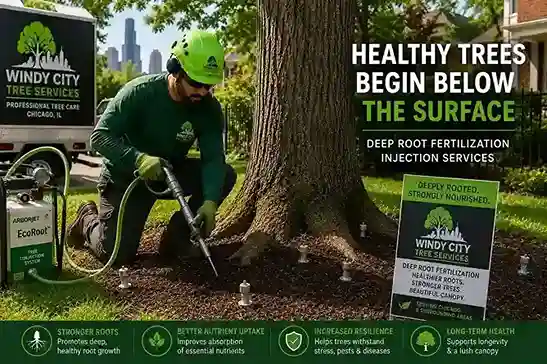
Healthy Soil Is Where Healthy Trees Start
A tree’s roots can only absorb the nutrients available in the soil around them. In a forest, fallen leaves break down every year and feed that soil naturally. On a Chicago property, leaves get raked, lawns get mowed, and the soil underneath is often compacted clay left over from construction. That natural nutrient cycle never gets the chance to run.
Urban trees deal with more stress than trees in the wild: reflected heat from pavement, root space limited by foundations and sidewalks, and competition with turf grass for water and nutrients. Over time, this shows up as slower growth, thinner canopies, and trees that struggle to recover from drought, storm damage, or pest pressure.
Professional fertilization addresses this directly. Instead of guessing at a blanket treatment, a certified arborist evaluates your soil, your tree’s species and condition, and the site history before recommending a nutrient plan. That diagnostic step is the real difference between a professional program and a bag of fertilizer from the hardware store.
Store-bought products are formulated for general use and applied at the surface, where lawn roots intercept most of the nutrients before they ever reach a tree’s root system. Professional fertilization places nutrients where your tree’s roots can actually use them, at rates matched to your soil and species, not a one-size-fits-all bag.
Signs Your Trees or Shrubs Need Fertilization
Most nutrient problems show up gradually. These are the symptoms we see most often on Chicago properties.
Slow Growth
Noticeably less new growth each year compared to seasons past.
Yellow or Pale Leaves
Chlorosis outside of fall often signals a nutrient deficiency, not just the season.
Sparse Canopy
A thinning crown with visible gaps where foliage used to be full.
Smaller Leaves
Leaves that are visibly undersized compared to a healthy tree of the same species.
Early Leaf Drop
Leaves falling weeks ahead of the normal seasonal schedule.
Weak Annual Growth
Short twig extension at the branch tips, a key indicator arborists check first.
Poor Flowering
Fewer or smaller blooms on flowering trees and shrubs than in previous years.
Thin Shrubs
Hedges and privacy shrubs that look gappy instead of dense and full.
Soil Compaction
Hard, dense soil near the base that water and air struggle to penetrate.
Construction Stress
Decline that started after nearby digging, grading, or equipment traffic.
Our Tree & Shrub Fertilization Services
Every program starts with an assessment, then builds a treatment plan around your specific trees, shrubs, and soil.
Deep Root Fertilization
Nutrients injected into the active root zone for trees that need targeted feeding past compacted topsoil.
Tree Nutrition Programs
A scheduled plan that matches feeding timing and formula to your tree’s species and growth cycle.
Shrub Fertilization
Customized feeding for hedges, flowering shrubs, and foundation plantings around your property.
Soil Conditioning
Amendments that improve organic matter, drainage, and pH so nutrients are actually usable.
Root Zone Improvement
Loosening compacted soil and improving aeration so roots can spread and breathe.
Seasonal Fertilization
Spring uptake support, fall reserve-building, and post-stress recovery applications.
Tree Establishment Care
Targeted nutrition for newly planted trees building their first root systems.
Landscape Health Programs
Whole-property nutrition plans covering every significant tree and shrub on site.
Commercial Tree Nutrition
Scheduled, documented programs sized for office parks, HOAs, and managed properties.
Annual Maintenance Plans
Recurring service scheduled around your trees’ actual needs, not a fixed yearly upsell.
We’ll Tell You If Your Tree Doesn’t Need It
Not every tree benefits from fertilization, and not every method is the right fit for every situation. A healthy, established tree growing in good soil with normal annual growth often needs little or no supplemental feeding. We assess growth rate, leaf color, soil condition, and site history before recommending treatment, and we’ll say so plainly if your trees look fine as they are. Our goal is a healthier landscape, not a recurring invoice for nutrients your trees don’t need.
Our Fertilization Process
A consistent, seven-step process from first call to ongoing care.
Initial Consultation
We discuss what you’re seeing, your property’s history, and what you want from your landscape.
Tree & Shrub Inspection
An arborist examines foliage color, canopy density, and recent growth on every tree and shrub in scope.
Soil & Root Zone Assessment
We check compaction, drainage, and pH, and recommend soil testing when a custom blend would help.
Customized Fertilization Plan
A written plan covering formula, method, timing, and cost, built around your specific trees.
Nutrient Application
Deep root injection, surface application, or a combination, applied at the depth and rate your trees need.
Health Evaluation
We follow up to track canopy color, growth, and overall response to treatment.
Ongoing Care Recommendations
Guidance on watering, mulching, and next steps, with a re-treatment schedule only if your trees need it.
Benefits of Professional Fertilization
When a tree genuinely needs supplemental nutrition, a properly applied program can support these outcomes over time.
Stronger Root Systems
Nutrients placed in the root zone support deeper, more resilient root development.
Better Nutrient Absorption
Correcting soil conditions helps trees use the nutrients already present, not just new ones.
Improved Canopy Density
A fuller, more even canopy as the tree directs energy into healthy new growth.
Healthier Foliage
Greener leaves and reduced chlorosis when the underlying cause is a nutrient deficiency.
Better Drought Tolerance
A well-developed root system holds up better through Chicago’s dry summer stretches.
Greater Resistance to Stress
Well-nourished trees are better equipped to recover from pests, disease, and storm damage.
Faster Recovery After Stress
Trees recovering from transplant shock, construction damage, or storm injury often respond more quickly.
Longer Tree Lifespan
Addressing soil and nutrient issues early helps prevent slow, avoidable decline.
Improved Landscape Appearance
Fuller canopies and healthier shrubs support your property’s curb appeal and value.
Trees & Shrubs We Commonly Fertilize
Different species have different nutrient needs, root structures, and tolerance for Chicago’s clay soil. We see these species often, and every plan is built around the specific tree in front of us, not a generic formula.
Ash trees deserve special mention: stressed or nutrient-deficient ash are more vulnerable to emerald ash borer, an invasive pest that has killed a large share of Chicago’s ash population. Keeping an ash tree well-nourished is one part of a broader EAB management plan, alongside proper monitoring and, where appropriate, insecticide treatment from our tree health inspection team.
Residential & Commercial Tree Care
Residential Fertilization Services
From a single shade tree to a full landscape, we build a program around what’s actually growing on your property.
- Shade trees that anchor your yard
- Ornamental and flowering trees
- Privacy hedges and screening shrubs
- Flowering shrubs like hydrangea and lilac
- Newly planted trees establishing root systems
- Mature landscapes needing seasonal maintenance
Commercial Tree & Shrub Care
Property managers and businesses get documented, scheduled programs that protect the landscape investment.
- Office complexes and business campuses
- HOAs and apartment communities
- Shopping centers and retail properties
- Schools and municipal properties
- Healthcare facilities and industrial sites
- Property managers overseeing multiple sites
Why Choose Windy City Tree Services
Fertilization done right takes more than a sprayer and a bag of granules. Here’s what we bring to the job.
Experienced Arborists
Crews trained to read what a tree’s foliage and growth are actually telling us.
Customized Plans
No blanket programs. Every plan is built for your soil, species, and site history.
Science-Based Recommendations
We base treatment on assessment and, when warranted, soil testing, not a default upsell.
Modern Equipment
Commercial-grade injection equipment for accurate depth, spacing, and application rates.
Honest Assessments
We’ll say plainly when a tree doesn’t need treatment, even if that means a smaller invoice.
Long-Term Tree Health
We aim for fewer, better-targeted treatments over time, not maximum service frequency.
Residential & Commercial Expertise
From backyard trees to multi-acre commercial sites, the same diagnostic approach applies.
Local Chicago Experience
We know the city’s clay soil, common species, and the stress urban trees deal with daily.
Tree Care Tips for Healthier Roots
Fertilization works best alongside good basic care. These habits make the biggest difference between visits.
Water deeply, not often
Slow, deep watering encourages roots to grow down instead of staying shallow.
Mulch correctly
Keep mulch 2 to 3 inches deep and away from the trunk. Volcano mulching invites rot and pests.
Avoid soil compaction
Limit foot and vehicle traffic over the root zone, especially during construction projects.
Protect root systems
Fence off root zones before digging, grading, or running heavy equipment nearby.
Schedule seasonal inspections
Catching early signs of stress is easier and cheaper than treating advanced decline.
Prune correctly
Clean, proper pruning cuts heal faster and reduce entry points for disease.
Monitor tree health year-round
Leaf color, growth rate, and canopy density tell you more than a once-a-year glance.
Know when to fertilize
Fall and early spring are typically the most effective windows for most Chicago species.
Tree & Shrub Fertilization FAQs
How often should trees be fertilized?
It depends on the tree and the soil. A healthy, established tree in good soil may only need fertilization every two to four years, if at all. Trees under stress, growing in poor soil, or recovering from damage may benefit from a more frequent schedule. We base the interval on assessment, not a fixed calendar.
When is the best time to fertilize trees in Chicago?
Late fall, after leaves drop but before the ground freezes, is often the strongest window, since trees store nutrients for winter and spring growth. Early spring before new growth begins is also effective. We avoid fertilizing during summer heat, when added salts can stress an already-thirsty tree.
Do mature trees need fertilization?
Sometimes, but not automatically. A mature tree with a full canopy, good annual growth, and healthy leaf color often doesn’t need supplemental feeding. Mature trees showing thinning, slow growth, or stress symptoms are the better candidates for a nutrition program.
What is deep root fertilization?
Deep root fertilization injects liquid nutrients into the soil at root depth, bypassing the grass and surface compaction that often intercept granular fertilizer. It’s a common method for compacted or turf-covered sites. Worth knowing: most of a tree’s active feeder roots actually sit in the top several inches of soil, not far underground, so the value of deep root fertilization comes mainly from getting nutrients past competing turf roots and loosening compacted ground, rather than reaching unusually deep roots. We’ll explain which delivery method fits your site during the assessment.
Can fertilization improve tree health?
Yes, when the underlying problem is actually a nutrient deficiency. Fertilization is not a universal fix. Trees declining from disease, severe root loss, or structural damage usually won’t respond to feeding, because the problem isn’t a lack of nutrients. We assess the cause before recommending treatment.
Is fertilization safe for pets?
Deep root injection places nutrients below the surface, which limits surface contact compared to broadcast granular products. We’ll let you know if any precautions apply to your specific treatment, such as keeping pets off treated areas for a short window after a surface application.
How long does the service take?
A typical residential property takes one to two hours, depending on the number of trees and shrubs being treated. Larger commercial properties or full landscape programs take longer and are scheduled in advance.
Do shrubs require different fertilizer than trees?
Often, yes. Flowering shrubs like hydrangea and lilac, for example, can have different nutrient ratios than shade trees like oak or maple. We formulate shrub treatments separately from tree treatments when the species call for it.
Do you provide annual maintenance plans?
Yes. We offer recurring care plans for properties that want ongoing monitoring and scheduled treatment. The frequency is set based on what your trees actually need, not a fixed annual upsell.
Can commercial properties schedule recurring service?
Yes. We work with property managers and HOAs on documented, recurring fertilization programs that fit budget cycles and minimize disruption to tenants or customers.
How do I know if my tree needs fertilization or something else?
Yellowing leaves, slow growth, and a thinning canopy can come from nutrient deficiency, but they can also signal pests, disease, root damage, or watering problems. Our tree health inspection identifies the actual cause before we recommend treatment.
Will fertilizer burn my lawn or nearby plants?
Properly applied deep root fertilization places nutrients below the turf root zone, which reduces the risk of surface burn compared to over-applying granular fertilizer by hand. We calibrate application rates to avoid over-fertilizing nearby plantings.
Can fertilization help a tree recover from construction damage?
It can support recovery when root or soil damage is the underlying cause, often combined with soil decompaction. For trees with severe root loss or structural injury, fertilization alone may not be enough, and we’ll be upfront if that’s the case.
Do newly planted trees need fertilizer right away?
Not always immediately. Newly planted trees are focused on establishing roots, and heavy fertilization too soon can sometimes push leaf growth at the expense of root development. We time establishment care to support root growth first.
What’s included in a soil assessment?
We check compaction level, drainage, and visible soil condition on-site, and recommend a formal soil test when the results would change our recommendation, such as a suspected pH imbalance.
Do you offer free estimates for fertilization?
Yes. We provide a free, no-obligation assessment and written estimate before any fertilization program begins.
Serving Chicago & Surrounding Communities
Windy City Tree Services provides tree and shrub fertilization for homeowners and businesses throughout Chicago and nearby communities, including the following ZIP codes.
Give Your Trees the Nutrients They Need
Healthy trees begin with healthy roots. Get a free, no-obligation assessment from a licensed, insured Chicago tree care team.